


Page 18 - Demo
P. 18
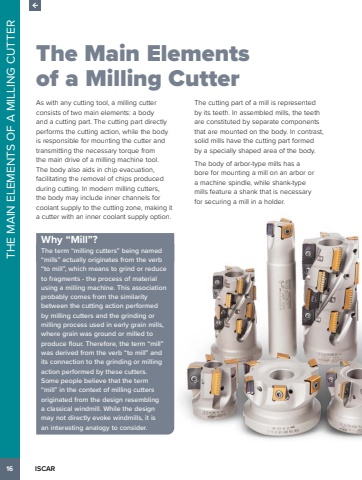
16 ISCAR THE MAIN ELEMENTS OF A MILLING CUTTERThe Main Elements of a Milling CutterAs with any cutting tool, a milling cutter consists of two main elements: a body and a cutting part. The cutting part directly performs the cutting action, while the body is responsible for mounting the cutter and transmitting the necessary torque from the main drive of a milling machine tool. The body also aids in chip evacuation, facilitating the removal of chips produced during cutting. In modern milling cutters, the body may include inner channels for coolant supply to the cutting zone, making it a cutter with an inner coolant supply option.Why %u201cMill%u201d?The term %u201cmilling cutters%u201d being named %u201cmills%u201d actually originates from the verb %u201cto mill%u201d, which means to grind or reduce to fragments - the process of material using a milling machine. This association probably comes from the similarity between the cutting action performed by milling cutters and the grinding or milling process used in early grain mills, where grain was ground or milled to produce flour. Therefore, the term %u201cmill%u201d was derived from the verb %u201cto mill%u201d and its connection to the grinding or milling action performed by these cutters.Some people believe that the term %u201cmill%u201d in the context of milling cutters originated from the design resembling a classical windmill. While the design may not directly evoke windmills, it is an interesting analogy to consider.The cutting part of a mill is represented by its teeth. In assembled mills, the teeth are constituted by separate components that are mounted on the body. In contrast, solid mills have the cutting part formed by a specially shaped area of the body.The body of arbor-type mills has a bore for mounting a mill on an arbor or a machine spindle, while shank-type mills feature a shank that is necessary for securing a mill in a holder.


